The first thing I noticed about Nighthawks was that there's no way in. No door anywhere in the frame. There are four people inside a late-night diner, and anyone looking at the painting is standing in the dark outside the glass. The brighter it is inside, the darker it gets out there. Hopper painted this kind of picture his whole life.
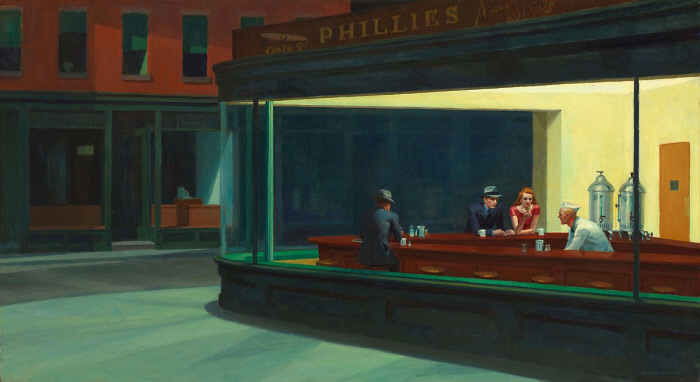
There's No Door Into the Painting
Nighthawks was finished in January 1942 — less than two months after Pearl Harbor. Whether the weight of that war made it into the painting, Hopper never said. The diner it was based on was in Greenwich Village, the New York neighbourhood where Hopper lived for 54 years.
The composition is unusual. The viewer is positioned outside the glass, looking down at four people inside. A couple sits together. A man sits alone. A counterman works behind the bar. None of them are talking. They share a space but each one is looking somewhere else — and the person looking at the painting can never get inside. The entrance isn't in the frame.
Without Josephine, There Would Have Been No Women in His Paintings
The red-haired woman in Nighthawks was modelled by Hopper's wife, Josephine. That might sound like a footnote, but Hopper couldn't use any other female model — Josephine wouldn't allow it.
Josephine Nivison Hopper was a painter herself, known first for her watercolours. In 1923 she introduced Edward to a gallery and his first watercolour exhibition followed — without that, he would have stayed obscure for years longer. The two kept separate diaries, and what's in them reads like a long marriage-as-war. Josephine posed for every female figure in Hopper's paintings and kept detailed records of every work — titles, sketches, notes — in her own journals. Without those journals, the provenance of much of his catalogue would simply be gone.

Hopper Wasn't Trying to Paint Loneliness
It's natural to look at Nighthawks and feel something lonely. But Hopper reportedly bristled when the question came up. What he said was: "I was painting what I saw in the city. Unconsciously, probably, I was painting the loneliness of a large city." The word "probably" is doing a lot of work in that sentence.
What he was actually obsessed with was light. The way late afternoon sun hits a brick wall. The way it comes through glass. The shadows that artificial lighting makes. When he followed that light, people ended up inside it — and when you look at those people, the loneliness comes. Whether that's the viewer projecting or Hopper putting it there, it might not matter much. You stand in front of the painting and feel alone either way.
Nighthawks was painted over eighty years ago and it's still being printed on posters and referenced in films. Whatever Hopper intended, people keep finding something in it. If the inside of the glass is bright and the outside is dark — where are you standing right now? That's the question the painting has been asking for eight decades.
Summary
So to put it simply: Nighthawks was completed in January 1942, shortly after Pearl Harbor, and was based on a diner in Greenwich Village where Hopper lived for 54 years. The key thing about the composition is that there's no door — the viewer is always locked outside the glass. The red-haired woman is Josephine, Hopper's wife and fellow painter, who was his only female model and the person who documented his entire body of work. Hopper said he wasn't consciously painting loneliness, but everyone who looks at the painting feels it. Some paintings take on more than their maker put in — and keep giving it back for generations.
#EdwardHopper #Nighthawks #AmericanArt #ArtEssay #JosephineHopper #Painting #Isolation #ArtHistory #ModernArt #AmericanRealism
'English Ver.' 카테고리의 다른 글
| I Had No Idea Coffee Was This Complicated — From Cherry to Cup (0) | 2026.06.15 |
|---|---|
| Move Fast and Time Slows Down — What Happens If That's Actually True (0) | 2026.06.13 |
| My Paycheck Went Up — So Why Am I Still Broke? (0) | 2026.06.12 |
| From Bean to Bar — How Cacao Becomes Chocolate (0) | 2026.06.10 |
| Kamakura — Eleven Minutes Standing in Front of the Great Buddha (A Day Trip from Tokyo) (0) | 2026.06.09 |