Keywords: DNA replication, DNA replication process | Date: 2026-05-22
After we talked about the DNA double helix, I bet a question came to mind — how does a cell actually copy all that DNA when it divides? Today, let's answer that.
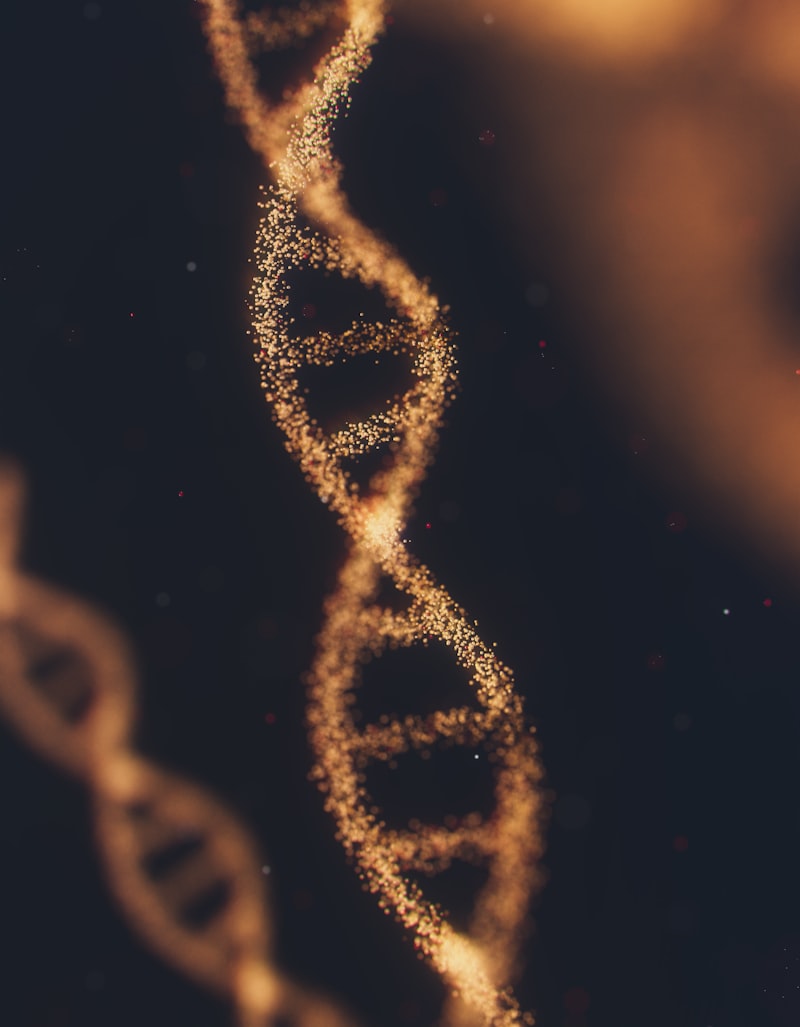
[Image: DNA replication illustration (Source: Unsplash, free for commercial use)]
Why Does DNA Need to Be Copied?
Our bodies produce millions of new cells every single day. Wounds heal, skin renews, organs maintain themselves — all of it runs on cell division.
When a cell splits into two, each daughter cell needs its own complete set of DNA. That means the original DNA has to be copied accurately before division begins. That's DNA replication.
The First Step: Unzipping the Double Helix — Helicase
Replication starts by opening up the double helix.
The enzyme Helicase moves along the double helix, breaking the hydrogen bonds between the two strands. The DNA peels apart into a Y-shape — called the Replication Fork. Think of it like pulling a zipper open from the middle.
How Is the New Strand Made? — Primers and DNA Polymerase
DNA Polymerase can't start from scratch on its own. It needs a short RNA Primer to attach first and mark the starting point.
Once the primer is in place, DNA Polymerase adds bases one by one: A across from T, C across from G.
One strand (leading strand) is built continuously. The other (lagging strand) is built in short Okazaki fragments, then joined by DNA Ligase. Same source DNA, completely different approach.
How Does It Stay So Accurate?
For every billion bases copied, only about one error slips through.
DNA Polymerase has a built-in proofreading function. If a wrong base gets added, the enzyme catches it, removes it, and tries again. It's like a copy machine with an automatic spell-checker.
When this accuracy breaks down, mutations occur — and in serious cases, that can lead to cancer. That's why this mechanism matters so much in medical research.
----------------------------------------
It's pretty remarkable that a single cell runs all of this automatically. Next, let's talk about what happens when this process goes wrong — mutations and cancer.
#DNAReplication #DNAReplicationProcess #Helicase #DNAPolymerase #BiologyBasics #OkazakiFragments #CellDivision #Genetics #ScienceFacts #Biology101