Most people know Munch from one painting — The Scream. That twisted figure under a blood-red sky, hands pressed against its ears. You've probably seen it. But why Munch painted something like that, and what kind of life he was living when he did — that part usually gets skipped. That's what this is about.
What Started at Age Five
Munch's mother died when he was five. Tuberculosis. Nine years later, his sister Sophie died from the same disease. Munch was fourteen.
After that, his father turned to religious obsession, and the family lived in poverty. Munch later wrote in his diary: "Disease, madness and death were the black angels that kept watch over my cradle." That wasn't a metaphor. That was his life.
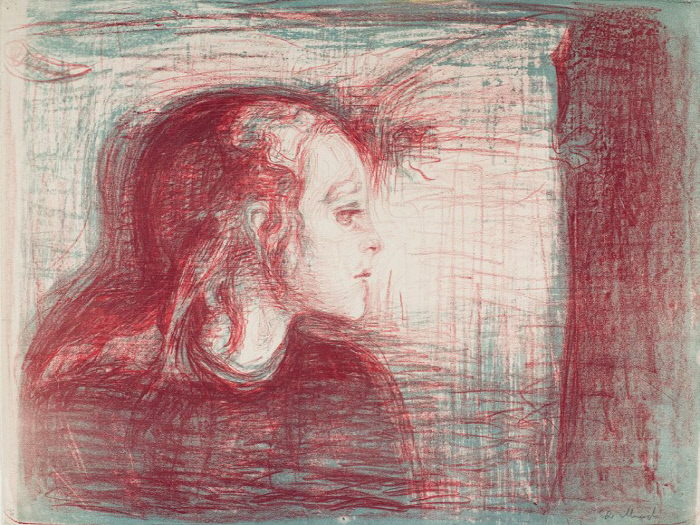
The image of Sophie sitting up in bed before she died stayed with him. He painted it as "The Sick Child" — and then painted the same scene six more times across his life. He couldn't let go of it.
What He Learned in Paris
Munch was talented enough to be selected for a French government study grant. In Paris, he encountered Post-Impressionism for the first time. Van Gogh hit him hard.
Where the Impressionists tried to capture what the eye sees, Van Gogh used colour to carry emotion — yellow holding grief, blue holding dread. Munch pushed that further. When he came back to Norway, his work changed. The colours went rawer. The lines twisted more.
The German Expressionists who came after him — Kirchner, Ernst — all traced their starting point back to Munch. He cut the path first.
The Scream Wasn't a Scream
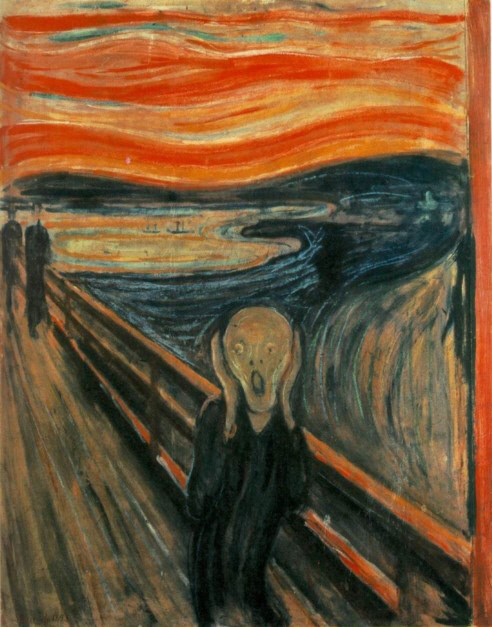
In 1893, Munch wrote in his diary about a walk with friends at sunset. The sky turned blood-red. His friends kept walking. Munch stopped. He wrote that he heard "an infinite scream passing through nature."
That moment became The Scream. But look at the figure in the painting — it isn't screaming. It's covering its ears. The scream is coming from outside, from the world and nature, and the figure is trying to block it out. The title is The Scream, but the subject is escape.
The Scream is part of a cycle called The Frieze of Life — a series on love, anxiety, and death that Munch worked on across his entire life. He made 34 versions of it. Not one painting, but a whole life organised as a single series.
After the Sanatorium, the Colours Changed
In 1908, Munch checked into a psychiatric clinic. He'd been drinking heavily, fighting, experiencing hallucinations. Eight months of treatment.
His work changed after that. The dark, distorted lines softened. The palette brightened. People said he'd been healed. Munch didn't see it that way. He later said: "Without anxiety and illness, I would have been a rudderless ship." He hadn't removed the darkness — he'd navigated by it his entire life.
Munch lived until 1944. He was 81. Fifty years after he painted The Scream.
Munch painted dark things not because he was sensitive, but because that's how someone lives after losing their mother at five and their sister at fourteen. The Scream isn't a scream. It's a record of that life.
Munch lost his mother and sister to tuberculosis in childhood, and that loss became the root of everything he painted. In Paris, Van Gogh showed him that colour could carry emotion, and he pushed that direction further than anyone had — becoming the starting point for all of German Expressionism. The Scream is not a standalone work but part of The Frieze of Life, a lifelong cycle on love, anxiety, and death. The figure in that painting isn't screaming — it's covering its ears. Trying to block out a sound coming from the world itself.
#EdvardMunch #TheScream #Expressionism #TheScream #WesternArtHistory #ArtAppreciation #ArtEssay #MunchLife #FriezeOfLife #ArtHistory