There's a place in the universe you can enter but never leave. Light can't get out. No signal can get out. Nothing. The boundary of that place is called the event horizon — and the strange part is that whoever crosses it has no way of knowing they just did.
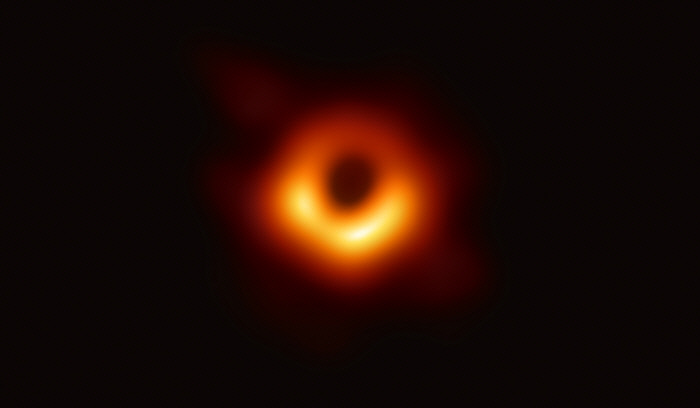
When a Star Dies, It Leaves a Hole
A star spends its whole life balanced between two forces. The outward push from nuclear fusion happening at its core, and the inward pull of its own gravity. When that balance breaks, the star dies.
A star much heavier than our sun reaches the end of its life and its outer layers explode — that's a supernova — while the core collapses inward in an instant. The pressure is so extreme that all that matter gets compressed into an almost impossibly small point called the singularity. Around that singularity, the gravitational pull becomes so strong that light itself can't escape. That region is the black hole.
The Event Horizon Is a Boundary With No Sign
The black hole itself is invisible — light doesn't come out, so there's nothing to see. But the boundary can be calculated precisely. It's called the Schwarzschild radius, and it scales with the black hole's mass: more mass means a wider event horizon.
What happens when you cross that boundary is genuinely strange. There's no signal. The boundary isn't physically there in any way you could sense — no wall, no pressure, no marker. It just looks like empty space. So you cross it without knowing you did. Only afterwards — when you can't get back out — does the crossing become real. By then it's too late.
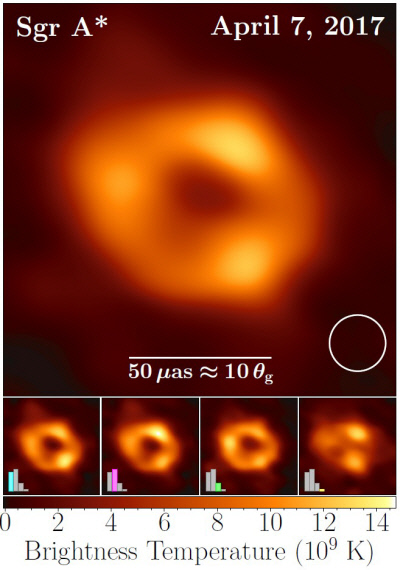
Time Stopping Is What It Looks Like From Outside
If you watch someone fall into a black hole, they appear to slow down as they approach the event horizon. General relativity says time moves more slowly in stronger gravity — this is the same principle behind GPS satellites needing time corrections, just pushed to its absolute limit. Right at the event horizon, the falling person appears to freeze completely, then fade away.
Ask the falling person and you get a different story. They don't feel any slowing. They don't notice crossing the boundary. They just fall until they hit the singularity. The same event has two completely different versions — one for the outside observer, one for the person inside.
Nobody knows what happens inside a black hole. At the singularity, the equations of current physics stop working. There's no formula for what that place is. We know that nothing comes back out once it crosses the event horizon, but what actually happens on the other side may be permanently unknowable. The honest answer to what's in there is that we don't have one.
Summary
So to put it simply: a black hole forms when a massive star's core collapses at the end of its life, compressing all that matter into a singularity of infinite density. Around the singularity, gravity is so strong that light can't escape — and the boundary of that region is the event horizon. There's no sign marking it, so whoever crosses it doesn't know they have. From outside, that person appears to freeze at the boundary; from inside, they experience nothing unusual and simply continue falling. Time runs differently depending on where you're standing, and what happens at the singularity is beyond what current physics can describe.
#BlackHole #EventHorizon #SpaceScience #GeneralRelativity #ScienceEssay #Astrophysics #TimeDilation #Singularity #Universe #Physics
'English Ver.' 카테고리의 다른 글
| The People on the Other Side of the Glass — What Edward Hopper Spent His Life Painting (0) | 2026.06.16 |
|---|---|
| I Had No Idea Coffee Was This Complicated — From Cherry to Cup (0) | 2026.06.15 |
| Move Fast and Time Slows Down — What Happens If That's Actually True (0) | 2026.06.13 |
| My Paycheck Went Up — So Why Am I Still Broke? (0) | 2026.06.12 |
| From Bean to Bar — How Cacao Becomes Chocolate (0) | 2026.06.10 |